Revealing Untold Asian Pacific Islander Histories
Discover important stories of Asian Pacific Islanders in America that have been erased or hidden. Our films bring truth and heritage to light, preserving rich cultural legacies.
Illuminating Heritage Through Documentary Storytelling
We craft documentaries focused on the first Asian and Pacific Islander communities in the United States. Through deep research and authentic footage, we restore erased narratives and honor the invaluable contributions of these communities to American history.

A 2024 survey
Systemic Issue
While it is impossible to quantify the exact number of Asian American and Pacific Islander (AAPI) stories that have been hidden or erased, evidence suggests it is a massive, systemic issue spanning centuries of U.S. history.
Ignorance of the Past: A 2024 survey found that 55% of Americans could not name a specific event or policy related to Asian American history, highlighting the success of this historical erasure.
2010 Study
A 2010 study found that AAPI leaders were mentioned in only 15% of analyzed history textbooks, with fewer than 3% portraying them as heroes or agents of change.
Key Missing
Info
While some milestones like the Chinese Exclusion Act (1882) or Japanese American incarceration (WWII) are sometimes taught, many events are omitted, such as the 1854 California Supreme Court case People v. Hall, which barred Chinese people from testifying against white people.

Extensive Historical Research
Our team uncovers original documents and oral histories to create factually rich and insightful films.
Authentic Visual Archives
We source and restore rare photographs and footage capturing the lives and heritage of API communities.

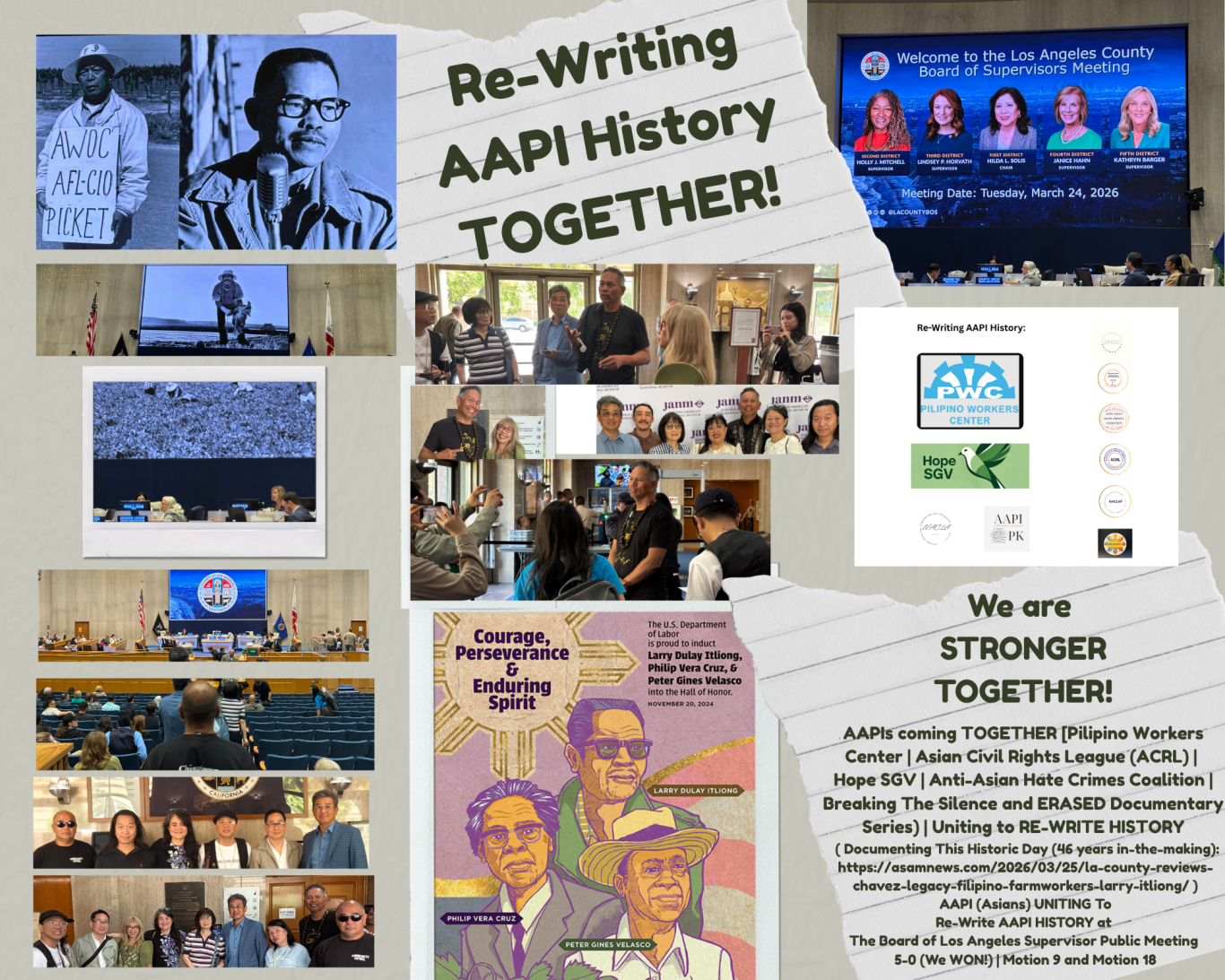
Re-Writing
AAPI (Asian | Filipino-American) History -
46 Years
In-The-Making
Re-Writing AAPI History at The Board of Los Angeles Supervisors on Tuesday March 24, 2026 | 5-0 | Motion 9 and Motion 18A | We WON!
(Highlighting contributions and influences of Asian Pacific Islanders in the formation of American society.)
The Board of
Los Angeles Supervisors approved (5-0)
Motion 9 and Motion 18A


Motion 9 and Motion 18A
Item 9 - Renaming County Honors for Cesar Chavez and Centering Survivors
Directs the County Chief Executive Office and County Counsel to develop a community-driven process for renaming parks, streets, County facilities, real property, monuments, and other programs that currently bear Cesar Chavez’s name, including the potential removal of related imagery in civic artworks. A report outlining the proposed process is requested within 21 days.
The motion asks that the report include a plan for multilingual, culturally competent outreach across impacted communities, including residents and non-profits. Recommendations should ensure that outreach is trauma-informed, allowing participation without stigma or fear of reprisal.
---
Item 18-A - Renaming Cesar Chavez Day to Farmworkers Day in Recognition of Farmworkers’ Resilience and Contributions
Renames the County holiday honoring Cesar Chavez as Farmworkers Day, beginning this year and annually thereafter.
On March 19, 2026, Speaker of the California State Assembly Robert Rivas and State Senate President pro Tempore Monique Limón announced legislation to rename the state holiday in the same way. This recognizes the legacy of farmworkers, addresses ongoing challenges, and reaffirms our commitment to their dignity and rights.
The motion directs the County Chief Executive Office to issue guidance to all County departments regarding the March 30, 2026 holiday. This includes removing the name and likeness of Cesar Chavez from all holiday-related events, communications, and materials, and refocusing events on farmworker justice, labor rights, and community service
Media: LA Times
Your morning catch-up: The UFW leaders you haven’t heard of, California is cracking down on suspicious luxury car sales and more big stories.
April 3, 2026 6:30 AM PT
The allegations that venerated labor leader César Chávez sexually assaulted teenage girls and also his longtime collaborator Dolores Huerta arrived like an earthquake. As the reverberations continue two weeks later, people who grew up in the farmworker movement are demanding another historical course correction.
They want greater recognition given to the many others who led the fight to win better wages and working conditions for some of America’s poorest people. High on that list would be Larry Itliong and Al Rojas.
Itliong died in 1977 and Rojas in 2021, but their children have been working hard to make sure their contributions are not forgotten. Chávez’s fall from grace created a moment for that message to get through.
Rojas’ daughter Desirée launched a website celebrating her father long before the New York Times broke the news that her older sister, Debra, had gone public with her account of being sexually preyed upon by Chávez when she was a teenager.
Itliong’s son, Johnny, has done nearly 20 interviews in recent days, assisted by the Asian Civil Rights League, in telling the world how his father began fighting for workers’ rights almost from the moment he got off the boat from the Philippines in 1929.
Organizing longshoremen, asparagus pickers and grape field workers
The elder Itliong hopped from town to town on the West Coast, organizing longshoremen in Seattle and asparagus pickers near Stockton. It was in the grape fields of the Coachella Valley in 1965 that the feisty, cigar-chomping Itliong and his allies made one of their biggest impacts — launching a strike to demand higher wages. A thousand workers under the banner of the Agricultural Workers Organizing Committee walked out. The wage increase they won marked a watershed, showing other poor workers that they could win through collective action.
That momentum carried on to Delano, which would become the epicenter of the farm labor movement. Many Filipino laborers moved north with the grape harvest and they soon called a strike and persuaded another organization, the National Farm Workers Assn., to join the walkout. Chávez headed the NFWA. The alliance led to the birth of the United Farm Workers of America, which would win some of the first contracts for agricultural workers in North America.
Though some UFW hagiographies leave little room for the Filipino leaders, even Chávez’s son Paul conceded how important their work had been. “They set the stage for everything,” the younger Chávez said in an interview, 40 years after the grape strike. “Nobody showed the kind of conviction these men did.”
The city of Delano named a park for Itliong. Union City named a middle school for him and another of the Filipino labor leaders, Phillip Vera Cruz. Itliong’s son Johnny said the renaming of other places would be fine, but that’s not his focus. He said his father would want a more universal message. Said Itliong, a former farmworker who now lives in Santa Monica: “His purpose was to raise everybody up.”
Rojas’ daughter Desirée feels much the same way. She was not even school age when her entire family moved to Pittsburgh in the late 1970s to support the UFW’s nationwide grape strike. They arrived with $50, their clothing stuffed in paper grocery bags, she recalled in an online homage to her father.
A migrant farmworker raised in Visalia, Al Rojas later ran a group called Citizens Against Poverty in Oxnard and kick-started an early union for field workers (the United Farm Workers Independent Union) that would merge with what became the UFW.
Organizing workers south of the border
Al Rojas also won acclaim for organizing workers in Mexico, believing that workers on both sides of the border had common interests. That differed vastly from Chávez, who disdained immigrants, believing their cheap labor held American-born workers back.
Desirée Rojas hasn’t given many interviews, unlike her friend Johnny Itliong. She hopes people will visit her website and understand the farmworker crusades were much bigger than César Chávez or any one individual.
“My mother and father taught us that helping other people is the greatest gift you can give, while teaching any person to do the same on this planet to create a ripple effect,” she said. “We have not forgotten that.”
James Rainey has covered multiple presidential elections, the media and the environment, mostly at the Los Angeles Times, which he first joined in 1984. He was part of Times teams that won three Pulitzer Prizes.
https://www.latimes.com/california/newsletter/2026-04-03/essential-california-farmworker-leaders-not-cesar-chavez
Educational Outreach
Our films engage audiences through schools, museums, and community programs to expand understanding and appreciation of API heritage.